What I'd Tell My Newly Diagnosed PCOS Self (From Someone Who's Been There)

Okay, come here. Sit down for a second.
I know exactly where you are right now, because I've been there too. The doctor said "PCOS/PMOS," maybe handed you a pamphlet, maybe mentioned birth control or metformin- maybe even fertility treatments, and then just sent you back out into the world. And the world looks the same as it did an hour ago, except it doesn't, and you're sitting in your car thinking, okay. Now what.
I remember that feeling (and the hysterical phone call I made to my recently married husband!). So let me just talk to you the way I wish someone had talked to me.
You are not broken or lazy.
For years before I got diagnosed, I collected explanations for what was going on in my body. The irregular cycles, the exhaustion that never really lifted, the acne, the weight that wouldn't budge, the hair loss and the mood swings that felt way bigger than me. People told me calm down, relax. PCOS is a real, physical thing happening with your hormones and insulin. It's not a character flaw and it's not something you did to yourself. Try to let that one go early, it's not doing you any good.
This diagnosis is a starting line, not a life sentence.
Right now it probably feels like a door slammed shut- but I want to say that It's actually more like a door opening. You FINALLY have information you didn't have before, and a real shot at building a plan instead of just guessing. There's no cure for PCOS, but it's one of the more manageable conditions once you understand your own version of it. Cycles regulate. Energy comes back. Skin clears up. You have more say in how this goes than this moment is letting you feel.
Please don't try to learn everything this weekend.
I did this. I opened about forty tabs and tried to cram insulin resistance, inositol dosages, seed cycling, and fertility odds into one afternoon. It's too much, and a lot of what's out there is outdated, contradictory, or just trying to sell you something. Give yourself permission to learn this in layers. This month, get a handle on your own labs and symptoms. Next month, pick one or two things to actually try. It's a marathon, not a cram session. When I finally sat down and put everything I'd learned into one place, it became The PCOS to Wellness Holistic E-Guide, the resource I wish someone had just handed me on day one instead of forty tabs.
Find a health professional who treats you like a whole person, not a checklist.
That might be your GP, an endocrinologist, a naturopath, someone who practices Chinese medicine, a functional medicine doctor, or a mix of a few of them. Not every provider knows PCOS well, and not every provider takes it seriously, especially the symptoms that are harder to measure, like fatigue or mood or how it messes with how you see yourself. If someone brushes you off or only wants to talk about your weight, you're allowed to find someone else. I mean that. Advocating for yourself in an appointment is a skill, and it gets easier the more you do it. Write your questions down beforehand. Ask them to explain their thinking. You know your body better than anyone. They know the science. You need both of you in the room, whichever kind of practitioner that turns out to be.
The mental health part isn't a side note.
Nobody warned me how much PCOS messes with mood, anxiety, and how you feel about yourself. It's not "in your head" in some dismissive way. It's tangled up in your hormones, your blood sugar, your sleep, and also in the grief of realising your body works differently than you thought it did. Let yourself feel that. Talk to someone if you can, a therapist, a support group, a friend who'll just sit with you instead of trying to fix it. Taking care of yourself here means taking care of your mind too, not just your ovaries.
Diet culture is going to come for you. Don't fall for it.
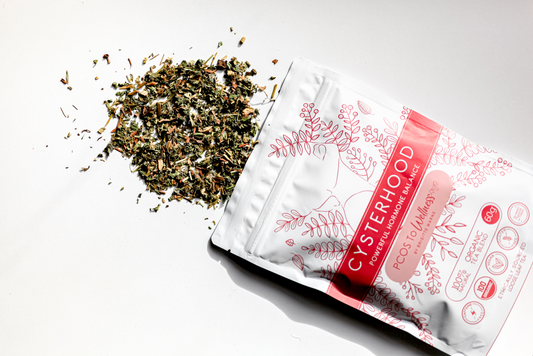
You'll see ads promising to "reverse" your PCOS in 30 days if you buy this program or cut out this food group. Some changes really do help, especially ones that support blood sugar and calm inflammation, but they work because you keep doing them, not because you punish yourself into them for three weeks. Be sceptical of anyone selling certainty, especially with a price tag and a countdown clock attached. Small stuff you can actually keep doing will beat an extreme plan you quit next month, every time. For me that small stuff ended up being something as simple as a daily cup of Cysterhood tea, not a miracle, just one steady habit I could actually stick to while everything else was changing.
Your worth was never about your fertility, your weight, your skin, or your hair.
PCOS can affect all four of those things, whether it's hair showing up where you don't want it or thinning out where you do, and our culture has a lot of opinions about all of them. But you are not less of a woman, less desirable, or less capable because your hormones do something different. I won't pretend that's easy to believe right away. It wasn't for me either. You don't have to fully believe it today. Just don't let anyone, including your own brain at 2am, convince you it's true.
You'll find your people.
One of the best things I did was stop trying to handle this completely on my own. There are whole communities of people living well with PCOS who will tell you what worked, what didn't, and what they wish someone had told them on day one. You don't have to figure this out from scratch, and you don't have to be quiet about it either.
That's actually exactly why I started my Instagram and blog in the first place. Long before PCOS to Wellness sold a single cup of tea, it was just a genuine community of women trying not to feel alone, sharing their stories, their wins, their bad days, all of it. That community is still the whole point, it's also why my friend Mel and I started The PCOS Girls podcast, so you'd have somewhere to hear other women talk about this stuff honestly, not just the highlight reel.
And last thing. You get to decide what "doing well" looks like for you.
This isn't about chasing some finish line where every symptom disappears forever. It's about building a life that fits your actual body and your actual mood, not the polished version the internet keeps showing you. Maybe right now "doing well" just means getting through the next appointment without dreading it. That's enough. Start there.
Where I am now.
I want you to know where this actually goes, because on that day it was hard to picture. I'm healthy. I'm happy. I've got two kids. And I still manage PCOS every single day, it hasn't gone anywhere and it probably never will completely, but these days it looks like small, realistic things I can actually keep up with, not some perfect routine I fall off after a week. That's the part I really want you to hear. It's not about fixing everything. It's about finding what's achievable for your life and sticking with it.
This is still your life to run. The diagnosis doesn't change that. It just means you finally have what you need to figure out the next part.
If you just got diagnosed and you're not sure where to start, you're not alone in this, and you don't have to figure it out by yourself. Come join us in The PCOS Girls Podcast Community on Facebook, it's free, and it's full of women who get exactly what you're going through.
xxx Brig